Physiotherapy · Kilcormac, Co. Offaly
Landmark-guided corticosteroid & local anaesthetic injections
Book an Injection Therapy AssessmentFollowing clinical assessment, a fine needle is used to deliver medication to an appropriate joint, bursa, tendon sheath or selected soft-tissue structure.
Unlike ultrasound-guided injections, landmark-guided injections do not require real-time ultrasound imaging during the procedure.
They are established techniques for a range of appropriately selected musculoskeletal presentations.
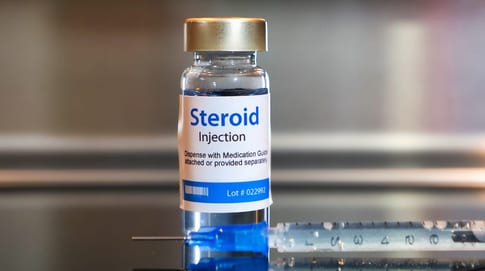
Injection therapy will only be recommended when the clinical assessment indicates that it is an appropriate option.
Corticosteroids are medications with a strong anti-inflammatory effect.
They may be used in selected musculoskeletal conditions where pain and inflammatory symptoms are associated with a joint, bursa, tendon sheath or surrounding soft tissue.
The aim is primarily to reduce pain and irritation, potentially allowing better movement and greater tolerance of rehabilitation.
Corticosteroid injections are not designed to regenerate tissue or permanently correct the underlying cause of every musculoskeletal condition.
The amount and duration of symptom relief varies between patients and between conditions.
A local anaesthetic may be administered alongside the corticosteroid where clinically appropriate.
Its primary purpose is analgesia — temporary reduction of pain.
The local anaesthetic usually works considerably faster than the corticosteroid and can result in temporary numbness or a noticeable reduction in symptoms around the treated area.
This early analgesic response may also provide useful clinical information about whether the treated structure is contributing significantly to your symptoms, although it is interpreted alongside the overall clinical assessment.
The local anaesthetic effect is temporary. The corticosteroid component, where used, generally takes longer to exert its effect.
Persistent musculoskeletal pain can sometimes create a cycle — pain limits movement, movement limits strengthening, and deconditioning keeps symptoms going.
For selected patients, injection therapy can help interrupt this cycle. Reducing pain may allow you to:
This is why we view injection therapy as a potential facilitator of rehabilitation, rather than simply a stand-alone pain treatment.
Injection therapy may be considered for selected musculoskeletal conditions involving the upper and lower limb. Suitability depends on the individual diagnosis and clinical assessment.
Subacromial bursitis, rotator cuff-related pain and frozen shoulder where clinically appropriate.
Tennis elbow, golfer's elbow, carpal tunnel and selected hand and wrist presentations.
Trochanteric bursitis and greater trochanteric pain syndrome in selected cases.
Knee osteoarthritis, joint effusions and selected bursal or soft-tissue conditions.
Plantar heel pain, plantar fasciopathy and selected tarsal presentations.
Selected tendinopathy and tenosynovitis presentations where corticosteroid is indicated.
Most people experience some brief discomfort as the needle enters the skin.
You may also experience pressure or discomfort while the medication is administered.
When local anaesthetic is used, the area may feel numb or considerably less painful shortly afterwards.
Some patients experience temporary soreness or a post-injection flare during the following day or two.
Your clinician will explain what you may expect following the procedure and when you should seek further advice.
All medical procedures have potential risks. Although corticosteroid injections are commonly performed and serious complications are uncommon, potential adverse effects can include:
Repeated corticosteroid injections into the same region may carry additional risks.
This is why injection frequency, previous treatment and the tissue being treated are considered during clinical decision-making. Corticosteroid should not simply be repeatedly injected into painful tissue without reassessing the underlying problem.
Injection therapy is not suitable for everyone. Additional consideration may be required if you:
This does not necessarily mean that everyone in these categories cannot have an injection. It means your circumstances need to be appropriately assessed before treatment.
We first establish whether the injection is appropriate rather than automatically treating the site of pain.
We provide landmark-guided corticosteroid and local anaesthetic injection therapy for selected musculoskeletal conditions.
Our focus is not simply symptom relief. Where appropriate, injections are integrated with physiotherapy, progressive strengthening and rehabilitation.
We understand the physical demands involved in returning to everyday activity, running, gym training and sport.
Depending on your condition, your management plan may also incorporate:
If joint, bursal, hand, wrist, foot or other musculoskeletal pain is limiting your movement, work, exercise or rehabilitation, we can assess whether injection therapy is an appropriate treatment option.
At Offaly Physio & Performance Lab, our approach combines landmark-guided corticosteroid and local anaesthetic injection therapy with physiotherapy and rehabilitation where appropriate. The aim is not simply to reduce pain — it is to help you use that improvement in symptoms to restore movement, strength and function.
Book An Injection Assessment